

Your Security Tools Answer the Wrong Question
They tell you if your encryption is secure today. Q-Scout 26 tells you when it stops being secure.

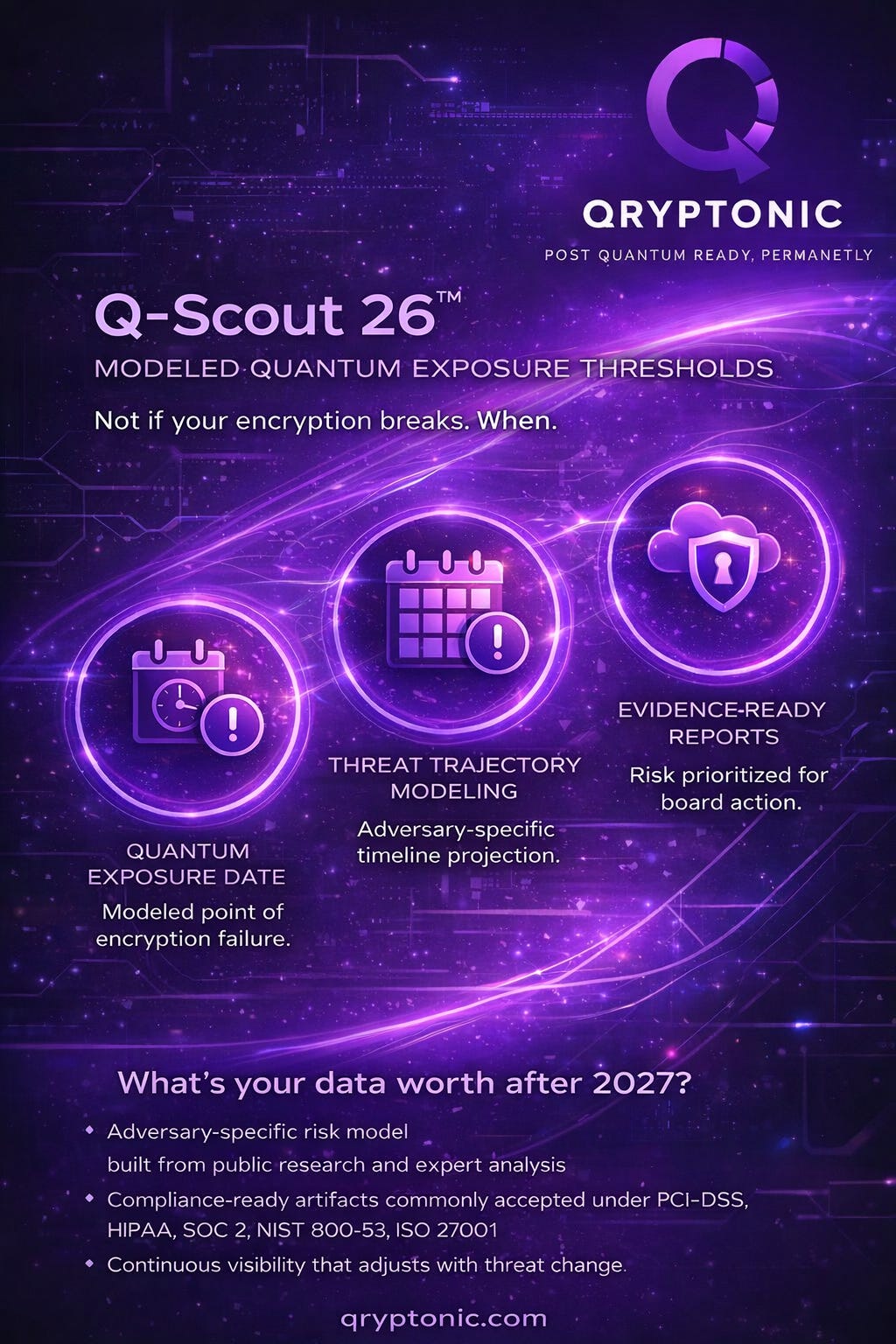
Every encrypted email your organization has sent. Every secure file transfer. Every API call. Every HTTPS session.
All of it can be captured. Right now. By anyone with access to network infrastructure.
That traffic is useless to adversaries today. The encryption holds.
The encryption won’t hold forever.
When quantum decryption matures, everything they’ve collected becomes readable. Not through brute force. Through mathematics. Shor’s algorithm doesn’t care how strong your encryption was in 2025.
Intelligence services understand this. They’re capturing encrypted traffic now and storing it for later. The NSA has warned about it. The attack has a name: harvest now, decrypt later.
The question isn’t whether your encryption is secure. The question is whether it outlasts your data.

The Number Boards Actually Need
A medical record generated today might need to stay confidential for fifty years. A merger communication might be sensitive for a decade. A defense contract might be classified for twenty-five years.
If that data is captured now and decrypted in 2032, when did the breach occur?
Not 2032. The breach happened when the data was transmitted.
Your board doesn’t want a lecture on quantum mechanics. They want to know: are we exposed? How exposed? When does it matter?
Q-Scout 26 provides a Quantum Exposure Date: a modeled threshold derived from adversary capability estimates and data confidentiality requirements, rather than requiring decision-makers to interpret cryptographic theory.
Your Quantum Exposure Date represents the modeled point at which encrypted data confidentiality assumptions fail under defined adversary capability scenarios and stated data retention requirements. It is calculated based on who targets your industry, what they’re capable of, and how long your data needs to stay confidential.
When the audit committee asks “what’s our quantum risk,” your CISO answers with a modeled exposure threshold and a plan. Not a shrug.
Not All Adversaries Are Equal
China’s quantum program is not Iran’s. The timeline for a defense contractor is not the timeline for a regional retailer.
Q-Scout 26 models adversary-specific capabilities. We track public research milestones, investment levels, published breakthroughs. We map your industry’s threat profile against realistic capability projections.
China-linked quantum computing programs are modeled with an estimated cryptographically relevant capability window beginning in the 2029-2031 range, based on publicly reported research progress and expert probability surveys. Russian, North Korean, and Iranian programs are modeled separately with different capability windows reflecting their documented investment profiles and technical approaches.
The output isn’t one number. It’s a risk model calibrated to your actual adversaries and their capability development programs as described in public literature.
A healthcare system with fifty-year data sensitivity windows faces different math than a financial services firm with seven-year retention requirements. Both might use identical encryption. Their exposure is completely different.
Generic quantum risk assessments miss this. Q-Scout 26 was built for it.
Why Your Current Tools Can’t Do This
Traditional security scanners evaluate encryption against today’s threat landscape. TLS 1.3 with strong cipher suites gets a green checkmark. Assessment complete.
That checkmark means nothing for data that needs protection until 2045.
No other production security assessment platform currently performs automated, continuous quantum-exposure analysis as a first-class assessment category. Existing tools were designed for classical threats. They evaluate whether encryption is strong today, not whether it survives tomorrow.
Q-Scout 26 evaluates encryption against future threat landscapes. We calculate whether your cryptographic posture outlasts your data’s sensitivity window. We identify where the gap exists. We prioritize remediation by the size of that gap.
This requires reasoning about time horizons, adversary capabilities, data classification, and cryptographic vulnerability in combination. We built Q-Scout 26 because the tools we needed didn’t exist.

Replaces Most External Penetration Testing
Q-Scout 26 isn’t just a quantum assessment. It’s a comprehensive security evaluation.
For most organizations, Q-Scout 26 replaces the majority of traditional external penetration testing required for compliance and risk assessment, while excluding physical, social engineering, and custom application red-team scope.
Q-Scout 26 produces assessment artifacts commonly accepted by auditors and assessors to satisfy external penetration testing and technical evaluation requirements under PCI-DSS, HIPAA, SOC 2, NIST 800-53, and ISO 27001, subject to assessor judgment and applicable program rules.
The deliverable package includes everything auditors typically require. Executive summary for boards. Technical findings with severity ratings and evidence. Methodology documentation. Attestation letter. Remediation verification.
For organizations with complex custom applications or specialized red team requirements, Q-Scout 26 provides the foundation. Either way, you get quantum exposure analysis that no traditional pen test includes.
What Makes the Analysis Different
We don’t just scan endpoints and report configurations. We reason about what those configurations mean.
Traditional tools output data points. Q-Scout 26 produces understanding.
We synthesize information from multiple threat intelligence sources, consuming public, licensed, and customer-authorized data. We correlate findings across your attack surface and track confidence levels, not just presence. We monitor how configurations change over time, not just their current state. We map technical findings to business context automatically.
The analysis engine behind Q-Scout 26 doesn’t apply static rules. It reasons about context. It understands that the same TLS configuration creates different risk for a healthcare provider than a retail chain. It calculates exposure windows based on your specific data sensitivity requirements.
Q-Scout 26 implements a production multi-agent review process that evaluates findings from opposing analytical perspectives and preserves the resulting evidence and rationale in the final report. Findings include confidence levels, assumptions, and supporting evidence. This is subject to human review and produces deterministic artifacts for audit purposes.
When Q-Scout 26 flags something as critical, that conclusion has been stress-tested from multiple angles.
Continuous Visibility
Point-in-time assessments tell you where you stood on the day of the scan. Your environment changes daily. New systems deploy. Certificates expire. Vendors update configurations. Acquisitions bring new infrastructure.
Q-Scout 26 provides continuous monitoring.
Your Quantum Exposure Score updates as your posture changes. Drift detection catches configuration changes that increase risk. Breach data matching alerts you when your assets appear in new compromises. Migration tracking shows progress toward post-quantum cryptography.
When threat intelligence updates our adversary capability estimates, you see what that means for your specific exposure window. Immediately.
This is what post-quantum readiness actually looks like. Not a report that sits in a drawer. Living visibility into cryptographic risk.

What You Get
Quantum Exposure Date. A modeled exposure threshold representing when encrypted data confidentiality assumptions fail under defined adversary scenarios and your stated data retention requirements.
Adversary-specific risk model. Capability development programs modeled from public literature and expert surveys. Not generic quantum speculation.
Compliance-ready deliverables. Assessment artifacts commonly accepted by auditors and assessors. Executive summary, technical findings, methodology documentation, attestation letter. Subject to assessor judgment.
Prioritized remediation roadmap. What to fix first. Sequenced by risk reduction. Mapped to your change windows.
Post-quantum migration guide. Which systems migrate first. Recommended algorithms. Practical implementation guidance.
Continuous monitoring. Ongoing visibility. Drift detection. Updated exposure calculations as the threat landscape evolves.
Initial assessment completes in days, not months, subject to scope validation and data availability. Continuous monitoring runs as long as you need it.
The Question Is Coming
Audit committees are reading about quantum risk. Cyber insurers are adding questionnaires. Procurement teams at federal contractors are checking boxes. NIST set a 2035 federal migration deadline for a reason.
“Are we quantum ready?”
That question is coming to your board. Probably sooner than you expect.
With Q-Scout 26, you answer with evidence. A modeled exposure threshold. An adversary-calibrated risk model. A remediation plan. Continuous monitoring that keeps the answer current.
Without it, you answer with hope.
One of those answers keeps your job.
Q-Scout 26™ — Modeled quantum exposure thresholds. Evidence your board can act on.
Q-Strike 26™ — Validate your defenses against quantum attack scenarios.
Q-Solve 26™ — Post-quantum migration architecture. Controls-mapped. Compliance-ready.
Powered by LLM 26.
www.qryptonic.com
info@qryptonic.com
LinkedIn: Qryptonic, LLC | X: @Qryptonic_ | Substack: qryptonic.substack.com
© 2026 Qryptonic Research, LLC. All rights reserved.
This publication is for informational purposes only and does not constitute legal, financial, or technical advice. Q-Scout 26 provides risk modeling and assessment artifacts to support informed decisions; it does not guarantee compliance outcomes, predict future events, or replace professional judgment. Consult qualified professionals regarding your specific circumstances.
Your Quantum Exposure Date concept is realy insightful. It shifts the perspective from static security to a dynamic, time-bound problem. Makes me think about our long-term digital legacy.
Holy crap, the harvest now decrypt later framing is spot on! Most security teams are still thinking about whether their encryption is secure TODAY instead of whether it outlasts the data sensitivty window. I've seen CISOs struggle to explain quantum risk to boards, and having a modeled exposure date would be an absolutley game-changer. This is exactly the kind of forward-looking risk assessment orgs need.